Making remote outsourcing effective

dilbert estimation

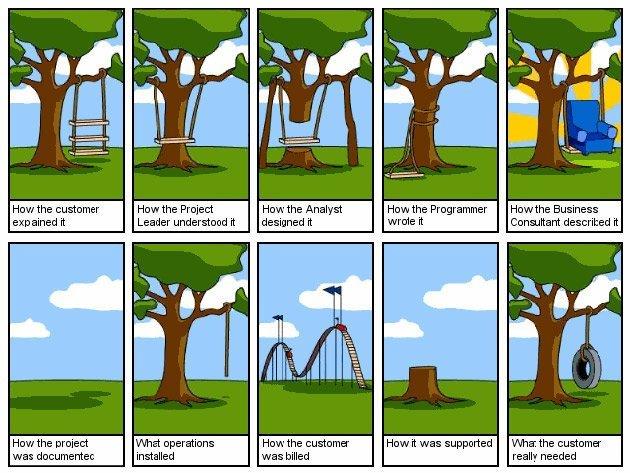
Seen this cartoon…it is very familiar to those in IT.

Given the huge divide between the onsite and offshore resources this inevitably happens on every other project if not every project. sometimes it applies on the whole, while at times it applies to portions of the project or work packets delivered. Keeping both sides- onsite and offshore, the vendor and the client on the same page takes a lot of skills, leadership, crisp reporting, keeping communication channels open, utilizing the available collaboration tools and fixing accountability and responsibility where it belongs.

Dont wait for things to cascade towards delivering a wrong product. it will be the case of Operation successful – Patient dead or Project complete and success but client tosses it out of the window since it didn’t meet his expectations he set before you began the project.

7 Sinkholes of IT Outsourcing (And How to Avoid Them!)

check out this nice article at Blue Print

Realizing full value from your third party supplier relationships begins with understanding and eliminating these seven risk factors that sink most outsource projects. Here’s a glimpse of what’s covered in this easy to scan, visual whitepaper:

•Why outsourcer attrition poses a huge threat and why onshore suppliers don’t solve the problem
•The root cause of virtually every failed outsourcing project, and what you can put in place to avert failures
•An easier path to getting business needs clearly articulated for all parties, right from day one
•The consequences for IT leaders when there’s no visibility into the outsourcing progress
It’s time to stamp out those high-risk factors that can turn your next outsource project into a high-cost failure.

http://www.voiceson-channel.com/?option=com_categoryreport&task=viewabstract&pathway=no&title=30126&frmurl=http%3a%2f%2fforms.madisonlogic.com%2fForm.aspx%3fpub%3d413%26pgr%3d768%26frm%3d1138%26autodn%3d1%26src%3d10000%26ctg%3d1%26ast%3d30126%26crv%3d0%26cmp%3d8992%26yld%3d0%26clk%3d5925620800547848659%26em%3dkgs55%2540hotmail.com%26eui%3d4FFDFX4D8EX1%26embed%3d1

Resourcing techniques…maintaining your talent

Resourcing is one of the most overlooked areas in outsourcing.  Clients enter into large contracts and often hand over the rights to  the vendor to bring in the needed talent.  This works to some extent more so when the arrangement is new when the outsourcing vendor is very particular to get this right to delight the client and improve business.  But once you reach optimal levels you see a big shift by the vendor to turn it to their advantage.    Clients are largely to blame.  In a staff augmentation mode, it is extremely important for both sides to agree the kind of talent you are looking for, skill sets, years of experience, soft skills, visa situation and everything that goes with it to make sure you have a resource that you can bank on.     

Bringing in the right resource at the right time is often a challenge and it could go either way translating to loss of precious outsourcing budgets.  The vendor could present a resource that is not fully qualified to close the open position, the client could sand bag interviewing a qualified resource who could be lost to another client since no one want to keep resources on the bench in a hot market, the client may agree to take the resource without even looking at the profile, the vendor may have inaccurately capture the needs the list goes on and on.  Having a  uniform and consistent procedure from the request stage to the post onboarding phase to declare a resource qualified to continue is the key. Note, onboarding does not end this cycle, a good six to eight weeks of review after onboarding is important to know if the resource is performing to the optimal levels. Most contracts provide for a free billable time if the resources doesn’t fit the bill after onboarding with a cap of 2-4 weeks. Utilize that.

 Swap resources when opportunity arises, use “ last in first out” principle or drop your bottom most performers.  Constant ramp up and ramp down is usual on large outsourcing arrangements due to project needs or end of the year scenario or due to funding situations which goes up and down depending on your IT budgets and initiatives at any  point of time.

 Review your talent pool.  It should look like a pyramid with senior resources at the top and the fresher’s at the bottom.  Your middle tier should almost exactly fit your pyramid while top talent is at the top.  Make sure the talent at the bottom is moving up or moving out.  Review periodically monthly, weekly yearly whatever is the best for the size of  your arrangement.  Maintain metrics on dashboard, verify the data is accurate and covers all resources and distribute at all levels, solicit feedback and update it as needed. Include all relevant data points, use charges and graphs to interpret so it is not just numbers. 

Remember resources are the biggest expense on an outsourcing agreement and maintaining a healthy talent will pay for itself. 

Getting used to Outsourcing

The other day I was attending large PMI symposium with hundreds of career project managers in Tampa Florida. During one of the routine lunch breaks which is open of networking I happened to be seated next to a gentleman that worked for a large accounting firm that ramped its outsourcing over last two years to an India based firm, he was critical of the whole outsourcing. He kept on complaining how nothing is working, the challenges he faced in his job and how this will eventually collapse and painted a picture of gloom and doom and went on ranting for the next 45 minutes. I did listen patiently, finished my lunch and wished him good luck, patience and told him to seek early retirement since he mentioned it was on his mind.

First things first, I am not saying that outsourcing is not without flaws or pitfalls. But look at the benefits as a CIO or CEO would look at it, you cannot ignore the ROI not just from economic sense, but for the ability to source what you want, when you want at a competitive price. Being a technology leader myself I have been situations when I sent assignments to my offshore team and next morning it was ready to be presented to the clients often to their surprise, they would ask me if I lost sleep trying to complete their assignment, and when I tell them that I went to sleep after sending it offshore over a brief call with instructions in the email and they sent it this morning, their jaws dropped. Imagine being 24/7, support or working round the clock from three locations – you can delight your clients for sure while cutting costs.

Every outsourcing arrangements has pitfalls, you just have to have the right leadership, experience and the patience to solve hurdles as you come across. Don’t imitate outsourcing just because others are doing it. The one size fits all wont work. Every business is different, and every outsourcing partner is different in some sense, e.g. some specialize in banking, Insurance, while others specialize in healthcare, engineering etc. there are specialized firms today in everything you do from VLSI to space technologies, Aviation, retain, telecom, Geo mapping so on and so forth.

I covered previously in my blog what to watch for as you go about making outsourcing arrangements. It would make perfect sense not just economic sense to outsource and in some case a case for survival of the company more so during recession. A Sustained campaign to train your staff on embracing outsourcing is the key. There are many firms today that specialize in sensitizing your staff on managing across boundaries. Explain the benefits and the situational need to outsource and providing scientific evidence on dealing with different culture and developing appreciation for it are some ways to keep the resistance low. Seeing colleagues lose jobs as outsourcing ramps up in most companies is not a great scenario for motivation and morale. This was not the culture that we all grew up with. I have worked in companies where three generations worked under the same roof and was common if not rare. It does breed a culture of some employees resorting to bickering and bad mouthing the company like my friend did to me at the lunch. The workplace is changing and rapidly at that for some of us to adapt and retool.

Outsourcing is here to stay, you can wish it goes away with insourcing but no, I dont see that even on the distant horizon.

Single outsourced vendor – Boon or bane

Most Outsourcing arrangements are often multiple vendor set up for very obvious reasons – allow them to compete on all fronts and gain pricing advantage. However there are cases where single vendor is an approach, this happens more from the vendor side that often tend to negotiate to be sole provider for a discounted price. The clients falls for it not knowing how this will impact in the long run. This is not an uncommon practice starting in early 70s, then 80 when large corporations in developed economies mostly in US and Europe outsourced their IT departments to concentrate on their core business.

It works well initially till the outsourced vendor entrenches itself, gains the confidence and then begins the downwards spiral. At times it has been quick within five to ten years, and some that slightly lasted more than that. In every relationship the initial years though it begins with struggle, you get the best top to bottom and once the investment phase is over the outsourced vendor starts looking at their bottom lines to see how they can squeeze more out of the deal. Hobnobbing for couple of years it is easy to get cozy at all levels and see the service levels drop unless there is a good way to measure and improve on the performance benchmarks. The initial bar set low should be gradually scaled so the contractual performance improves not stagnates.

The influence of senior management on single vendor situations are not uncommon. The appreciation and understanding at that top-level is not commensurate with what is happening at the ground. The need to support single vendor solution keeping in view the economies it provides to the clients bottom line tops all judgment. The message always to the lower cadres is to fall in line and keep the relationship going at all costs. It is only when the worst nightmares surface that management take notice and take remedial action, by that time the damage is done. Stories about of clients that lost all of its competitiveness, time to market, lost a ton of money, their brain power before they decided enough is enough and threw the vendor out and move on to other strategies from finding a new partner or totally bringing everything in house. It takes years depending on the size of the contract to get back in shape.

Single vendor relationships tend to look like a financial boon initially given the pricing advantage, however it tapers off very quick. It is always good to have atleast two if not more vendors compete for your outsourcing dollars. Every benchmark you care comes into play and competition plays it out driving the advantages and improving overall efficiencies

The Billing War

I am sure many of you that are involved in outsourcing have been part of the billing war in some form or fashion. Guess who wins every time, it is the outsourced provider. Most of the time the clients just give up or think they have bigger fish to fry so they move on. Like drops of water make an ocean, this adds up.

Most of the IT outsourcing contracts are geared towards ensuring providers have some leeway into protection of their billing. The era of fixed price bids is not a norm anymore solely due to the fact that it doesn’t work well for the providers, many have lost face and money in these type of deals which is again due to a host of factors that I will cover another time. The other billing types lime T&M, Staff augmentation, sole contracts etc. are fodder for billing leakages.

it is advisable to have a robust process to check billing and make sure the outsourcing dollars are spent wisely. Processing of invoices as they come in needs discipline and verification against time sheet data. The source being time sheets, it pays to have people signing off those to do their due diligence. At times there is no connection between those that approve time sheets and those that process invoices which is best avoided. You want both of these folks to be in sync to do what it takes to be accurate in processing bills.

Given the downturn almost all IT outsourced providers have tightened the belt on what they call “Billing Leakage”. Not just that they actively look for measures to see where they can tap out more billing often going for smaller lines. it helps since the clients really don’t look at smaller lines with that close eye it deserves.

Many providers have lost face or lost credibility due to this factor, at time the middle manager at these firms tend to be aggressive to exceed their targets with unscrupulous means. Most of the senior leadership at the providers are not about these smaller moneys coming at the cost of credibility and actually discourage such practices. It is not uncommon to have broken process that benefits providers, they simply refuse to make improvements for obvious reasons

Given the economic situation and the need to account for every dollar spent on outsourcing it is imperative to relook at the billing practices and processing workflow end to end from receipt of the bills to payments and take remedial action. Many firms will benefit from doing a wing to wing mapping using Lean Sigma. There is lot of money to be made here for clients in terms of savings and arrest the billing leakage from their ends.

IT Provider & Client Relationship – Short term goals Vs. Long Term goals

Most of IT big-budget, multi-year contracts are inked with months if not weeks of due diligence most often looking at the credentials of the firms and their leadership. Almost all of the big firms have exceedingly high reputation at their senior leadership levels with unmatched sincerity. Coming to smaller firms it takes them years to build that steadily one client at a time while they evolve to maintain their growth.

Let’s talk about the big firms specifically – The leadership enjoys high confidence among the corporates of the world for their sincerity for their willingness to work at personal levels to resolve differences, help clients concentrate on their business growth while they keep the IT shop humming leaders of IT, their accessibility and reach etc. Providers have won huge praise and awards from governments the world over for their contributions and their dedication in all sincerity.

There are ofcourse bad eggs in ever industry and IT is not insulated from it. Firms that promised much but didn’t deliver on the promise broke agreements and left clients in a lurch.

While the top leaders from IT providers develop long term relationships and grow the business the tasks of growing the holding the fort and delivery falls on the middle tier leaders often don’t follow the core principles their leadership used to bag the contracts and grow. The goals of middle tier is often grow their individual careers, look for short term revenue opportunities, one up man ship, unhealthy competition, poor client engagement, making untenable promises, politicking, pitting one against another, indulging in infighting, complaining on their client partnerships – just to name a few. Some are outright ill-qualified The analogy of “too big” to be thrown out of the client or multi-year contract also creates an atmosphere of protection for the middle tier leaders of the IT firms to be comfortable with.

This is one of the top issues that IT providers and their leaders struggle with but don’t make an issue for their clients to know that this exists. Often the middle level managers who are representatives of their leaders on client sites totally forget the principles of client engagement their bosses laid out and toe their own line often with negative consequences.

Aided by some of the negative pressures on outsourcing in developed countries from the locals this problems at times can spiral out of control. Some of the managers from IT providers are untrained and cannot fit in culturally or they reach client locations due to other considerations. Top tier IT firms have taken steps to train and mentor them before they join client sites which has helped alleviate this problem. However this exists in quite a good measure.

The vision and foresight to look at long term client relationship is not kept in view while dealing with day to day client engagement / client requests. A good part of the strategy of middle managers in IT firms is to look at making the quick buck forgetting the fact that these instances become a thorn in the flesh at growing business and actually exposes their firms to host of issues that come to bear during the renewal or extension of contracts and impede the growth of their organizations goals and objectives. Not to generalize there are few exceptions that actually end up rising to the top. The ability to sacrifice short term trivial benefit towards developing a relationship with the client for ever is often ignored. It takes a lot to bag a new client in the competitive market environment and retaining and growing it takes much more while losing the client due to short term opportunities at the cost of quality and client satisfaction is something IT providers should keep their eyes and ears open. If you study the growth of the global Big 3 consulting firms, their sole mantras has been towards keeping client interests very high on their radar and align to their long terms growth.

The philosophy of customer once – client forever, needs to be adopted by the IT Outsourcing firms and ensure everyone in their organization lives to their reputation to this motto.

Pain sourcing senior resources…

Most of the run of mill outsourcing providers have it easy providing resources with average years of experienced ranging from zero to 5 years, however ask for a senior resource they have trouble finding them. More so when your rates are tiered, fixed or lower than the prevailing market rates.

Sandbagging on bringing in senior resources when asked for is common. Extension of SLA to onboard with various excuses is not uncommon either. Instances of senior resources asking for higher comp, broader role, career growth etc. also hinders outsourced providers to shy away from bringing on senior resources though the client’s needs them or the role merits.

If you go flex on the rates you may get some result via contracting which has its own pit falls. The outsourced provider is at the mercy of a sub-contractor who could pull the plug any time. However if your rates are fixed you are often out of luck. Often on large outsourced contracts, you will find a vast majority of your resources are from the lowest tier 0-2 years of experience which helps providers keep their margins intact or even grow higher.

Ensure you have the talent you need; it makes sense to hire a full-time employee if the outsourced provider cannot give you the experience you need. Have competition – if one provider cannot provide, switch that open positions to another provider. Keep an eye on the overall talent pool, the experience band, some resources may seem experienced on the book, but their performance could be way down.

Reviewing your overall talent pool periodically is extremely important, it is perfectly okay to have a pyramid type structure, while watching the bottom tier. if it is too flat at the bottom you definitely have a problem.

Resources in abundance but Employability is bleak –The India outsourcing scenario

Filling large outsourcing requirements are not a issue, many of the India pure play firms have adequate resources to fill the gaps quickly. A good percentage of this comes from fresh graduates who come of colleges every year. India produces record number of engineering graduates a good chunk again coming from colleges that lack the basic facilities to teach with poor curriculum and teaching standards. The engineering graduates are not unemployable; they just don’t have industry-ready talent. In other words, they lack the skills required for the jobs that are available to them. Many of them struggle to communicate, cannot answer basic questions and depend on client’s dime to learn and move on with their careers. The quagmire for the clients worsens there and ends with the resources departing after they have gained some traction and actually begin delivering some efficiency.

According to Aspiring Minds, an employee assessment service provider’s 2012 National Employability Report about 83% of engineering graduates are unfit for employment. The report highlights that only about 17.45% of engineering graduates of the year 2011 were employable. National Association of Software and Services Companies’ (NASSCOM) survey of 2011 showcased that over 75% of IT graduates are not ready for jobs and further brought into notice how India’s $60 billion outsourcing industry is spending almost $1 billion a year training them to be fit for jobs.

Deemed unfit in communication skills, confidence, presentation, problem-solving capabilities and generic abilities, an alarming figure presenting hard reality has been brought out in notice. Aspiring Minds also revealed that over 50% graduates fall short of the mark in language and grammar as well.Another interesting finding showcased that graduates from Tier 2, Tier 3 and Tier 4 engineering colleges in India produced graduates that were not industry ready even after interventional training.
Most graduates display excellent theoretical knowledge. However, when it comes to problem-solving, they lack basic analytical skills. The approach to the engineering curriculum in India emphasizes rote (Rote learning is a memorization technique based on repetition) learning. The same set of questions is asked year after year. If your memorization skills are good, you may cram and score well. But that doesn’t mean that you have the skills the industry is looking for.

To cater to the problem of quality demand and supply, NASSCOM has planned to impart training and development of faculty. Having identified the gaps, industry experts foresee the need for improvement in current colleges as a priority as against bringing together newer courses and institutes for engineering.

The pain for clients meanwhile will continue, the learning curve is stiff. This doesn’t augur well for India’s once booming outsourcing market. Other countries like Brazil, Philippines, Poland, China and other near shore companies in West are moving ahead to cash in.

The Talent Poaching Wars

Talent poaching is very common in outsourcing hot beds of India, China, Philippines and other smaller IT oriented markets. This problem is more rampant when the market gets competitive. The supply and demand ratio creates a conducive atmosphere for poaching from each other. As the outsourcing percentage goes up calling for larger and qualified positions to be filled rapidly, this problem gets manifold. It is mostly movement from larger firms to small firm that happens, very little goes the other way.

The most common bait is a stiff raise, a promotion, or a visit onsite at client location. For those are struck in unreasonable positions this becomes an easy choice to bail out and get into a new opportunity. The fact that those resources coming from larger and well established organizations can hit the ground running from day one offers an attractive incentive.

It is not uncommon to see an IT consultant in outsourced firm who has 10 job changes in 10 years often working for a year or less and keep moving. Lack of career guidance and not knowing the damage they are doing to their long term career is ignored till they realize the damage is already done. In the similar light the recruiting agents overlook this fact to fulfill their short term needs and fill client requirements and grab the money on the table.

Recent steps by larger outsourcing firms to collaborate amongst each other and fight this battle together is paying some dividends. Also with economy slowing down it is hampering resources from bailing out. Lack of confidence that they may be left in lurch is forcing them to stay back in their well-entrenched positions unless the carrot is attractive enough and confidence levels to go with it is high. The days of HR agents standing outside major IT firms offering immediate raise and other perks as promises are almost over.

Big providers end up losing their talent to poaching which is translates into monetary loss and they end up doing the same to beat the trend at times. Overall this leaves a negative trend in the industry, this is a major contributor to the attrition percentage of top firms often hovering around a unhealthy 20% in some cases.

Poaching doesn’t really help anyone in particular. it does help some short term to fill a void but has consequences down the line. It encourages ill equipped and inexperienced resources to capitalize on the situation, doesn’t allow resources to get a solid experience that they can count on leveraging for delighting their clients.

Recruiting staff should pay closer attention to relaxing the resumes to ensure they are not aiding this problem in pursuit of short term staffing requirements. Using independent recruitment agents needs to be governed well to make there are no gaps in soliciting and proposing candidates. The problem of resumes being padded up is not uncommon, the lack of verification mechanism helps defaulters to get away.

Since this aids attrition, it makes sense to keep an eye on resource profile to weed out those that jump ship often. Remember every new employee addition and departure is an overhead given the number of touch points it has thru HR/Payroll systems and it gets expensive at some point and not economical to indulge in poaching as a substantial means to fill your knowledge gap. This problem doesn’t go away complete, as the economy rebounds and more jobs move offshore it will comeback all over again. It is better to have a plan to deal with this and ensure there are checks and balances to make sure recruitment teams are following it in letter and spirit.