
GDPR and Outsourcing

This year GDPR (EU General Data Protection Regulation ) roll out will bind all companies and organizations handling data of all individuals within the EU. From now on, companies can be held liable for the data it collects and uses. Fines up to €20 Million or 4% of annual turnover can be imposed.

Its race against time.  Outsourcing companies will be have to be compliant with  the GDPR regulation and organisation processing data outside of EU will need to put extra measures to protect personal data of EU nationals. This includes Binding Corporate Rules or Contract and additional measures to prevent data breach.  Any organisation might face  fines if they’re not paying attention to new data privacy developments in Europe, as penalties for mishandling European citizen data apply to all companies, not just those headquartered in the European Union.

Lot of different factors are in play towards eventual compliance ranging from Exposure to geography that GDPR covers, Commitment to compliance, volume of processes, vendor exposure and compliance, data gathred, training and change management etc

Step 1: Pre-Assessment
So before you start going down the compliance path you need to take stock of what your current state of compliance with regards to the General Data Protection Regulation (GDPR) framework actually looks like. The pre-assessment depends heavily on the size of your company and the processes you have. The aim is usually to figure out the resource commitment that your company needs to actually comply.

The important thing to remember here, is that setting the scope and ensuing commitment to your assessment as well as the extent of prior knowledge you have will play a determining role in how long pre-assessment will take.

Step 2: Creating Records of Processing Activities

Keeping Records of Processing Activities (RPA) is a stipulation of Article 30 of the GDPR explicitly requiring businesses to document their processing activities and recording the processing purposes, data sharing and retention. These records need to be made available upon request by the Information Commissioner’s Office (ICO).

Step 3: Evaluate the third parties

This is a critical step in being GDPR compliant and one that needs special attention since outsourcing and having several vendors is such an integral part of most businesses today. Vendor risk management (VRM) from a GDPR perspective is basically to make sure that all the services you use for your business do not violate your data protection regulations and create disruptions for you.

Step 4: Data Protection Impact Assessment

Data Protection Impact Assessment refers to estimating the entire risk for the company and it pertaining operations. Essentially, it means that an external person helps the organization to identify, assess and minimize the risk of their processing activities. A


Every European Union and the EFTA member assigns a national organization/commission/agency/bureau/authority that is in responsible for GDPR enforcement inside each country’s border by providing information and support, but also auditing and issuing sanctions and fines. Their status was formalized by the Data Protection Directive.

Find below a list of webpage links for the DPAs in various countries:

Andorra https://www.apda.ad/
Austria https://www.dsb.gv.at/
Belgium http://www.privacycommission.be/
Bulgaria https://www.cpdp.bg/
Croatia http://azop.hr/
Cyprus http://www.dataprotection.gov.cy/
Czech Republic https://www.uoou.cz/
Denmark https://www.datatilsynet.dk/
Estonia http://www.aki.ee/en
Finland http://www.tietosuoja.fi/en/
France https://www.cnil.fr/en/home
Germany https://www.bfdi.bund.de/
Greece http://www.dpa.gr/
Hungary https://naih.hu/
Iceland https://www.personuvernd.is/
Ireland https://www.dataprotection.ie/
Italy http://www.gpdp.it/
Latvia http://www.dvi.gov.lv/en/
Liechtenstein http://www.dss.llv.li/
Lithuania http://www.dvi.gov.lv/en/
Luxembourg https://cnpd.public.lu/
Macedonia https://www.dzlp.mk/
Malta https://idpc.org.mt/
Monaco https://www.ccin.mc/
The Netherlands https://autoriteitpersoonsgegevens.nl/
Norway https://www.datatilsynet.no/
Poland http://www.giodo.gov.pl/
Portugal https://www.cnpd.pt/
Romania http://www.dataprotection.ro/
Russia http://eng.rkn.gov.ru/
Serbia https://www.poverenik.rs/sr/
Slovakia https://dataprotection.gov.sk/
Slovenia https://www.ip-rs.si/
Spain https://www.agpd.es/
Sweden https://www.datainspektionen.se/
Switzerland https://www.edoeb.admin.ch/
United Kingdom https://ico.org.uk/
 

Impact of Globalization – Part 2

Globalization will bring faster transfer of technologies for firms that seek newer markets to expand their footprint and will push rapid adoption of exponential technologies that leans on accelerating technology — so network sensors, AI, robotics, synthetic biology, 3D printing — these technologies that are all on exponential growth curves. They’re also relying on what we call exponential psychological tools. These are crowdsourcing, crowdfunding, and community building, that let entrepreneurs get access to capital, get access to expertise, really scale up their reach farther than ever before. 

Future of outsourcing revolves around rapid agility towards understanding the driving forces like demographic changes, New work arrangements, launch of smart, connection systems / products and services, rise of highly optimized supply chains, rampant business innovation, demand for resourceful plant and sustainability – almost all of these will have a direct impact on outsourcing with shrinking of jobs in this sector.

Exponential technologies like Cloud, AI, Block Chain, Big data Analytics, Internet, social media, 3D printing etc while they drive innovation and rapid pace of technology change will bring havoc into the world of outsourcing if we cannot adapt quickly to it.  Traditional systems built-in eighties, nineties will give way to these new and hybrid models that require human element to adapt quickly.  The pace at which these take shape will be much faster than how last two decades shaped the technology world.  Cellphones are a classic example. Back in the ’80s, these were a luxury technology that only the wealthiest could have and then it kind of slowly moved down the scale until where we are today with more than 50% of the world population carrying a supercomputer in their pocket. That’s how fast technology will move and will become available for mass consumption leaving no one untouched.

These newer technologies get introduced and it takes a while for them to get up to speed, optimized and utilized. And there’s all this hype in the beginning and people kind of dismiss them. 3D printing was in that deceptive period for a very, very long time., now it is a reality.  

Robotics, AI, RPA – all the technologies that we’re talking about in Bold are now moving out beyond hype into reality.  The opportunities that 3D printing provides are endless, think about running out of home to buy a broken part, you can make it right at home, today a fully functional small car was made right out of 3D printer in less than 2 weeks.


Impact of Globalization – Part 1

Globalization has brought in tremendous changes  world over some good and some not so good.  This has troubled planners world over to adapt in several ways while others struggle to grapple with the rapid changes it has brought upon almost every sphere of our lives.  In Addition to Globalization, demographic changes and adoption of Industry 4.0 and exponential technologies in the next five years will have the highest impact on jobs by 2022.

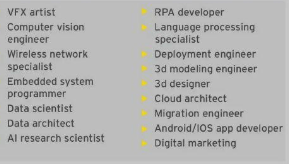
The outsourcing industry is not insulated by these impacts, they dont have the luxury of time to adapt to the fast changing landscape.  Looking at the sheer statistics it points to the huge change. 10% of this workforce will be thrust into new jobs that dont exist today, 40% into joins that require new skill sets and rest face an existential threat.   The picture below depicts the new roles that will need great deal of skills to  adapt and survive.

New job roles

Many traditional firms have done little than trying to play around the edges.  Selling digital technologies, cloud,  RPA and AI has been on the upswing without the underlying up gradation of current  resource pool via training or investing in the pipeline focused on the newer technologies and the emerging roles that has brought forth.

Almost all of the legacy firms continue to imagine that outsourcing will just move to these new roles for them to move into without understanding the skill set impact and the need to prepare from bottom up.  A good portion of these firms will lose their relevant, we are already seeing the impact of this slowly which will compound besides of course the Visa regime, rise of socialist parties championing against immigration from the under developed to developing countries. The success at the polls in some of the European countries that advocated open immigration is a wake up call.  These are certainly attributable to the impact of globalization.

Using process over Tech in outsourcing

In the age of RPA, AI we still have lot of lengthy documents of SOP (Standard Operating Procedures) in use today as part of outsourcing.  These are legacy ways of doing business that originated in the initial wave of outsourcing be it IT BPO or KPO.   Many of these didn’t take advantage of automation for various reasons, in same cases it was the reluctance of the business owners who feared for their jobs or wanted job security.  This is any leaders nightmare since these process often fail due to the human element involvement in executing looking at outdated documents.  Agreed, process need to be documented but not to a point they become useless to get work done efficiently.

The surprising element is proliferation of these and the belief of the business owners that hold on to these dear to their heart stating this works or this is the right way to do instead of looking at technology to reduce the sheer number of steps in each process. These are drag on business looking to be agile, innovate or reduce their time to market.  Some of these have become impediments to modernization or taking advantage of digital and emerging technologies.  With long term contracts some of these wait for its time to even get attention to modernize. The very existence of business is at stake with this legacy approach not to mention the hard and soft dollars spent on this besides lost opportunities.

Traditionally the operations team put out these lengthy SOPs to help enable outsourced providers run shops by the book.  Over a period of time these became a norm than looking to embrace technology and automate and thus reduce the process oriented work struck with human element getting it right all the time

These SOPs dont keep pace with technology changes happening in tandem  and remain outdated resulting in serious errors. These are high maintenance that leads to lot of wastage as well. Companies that have not embraced Agile, Scrum, Dev-ops suffer the worst fate of these lingering around slowing them down to make progress.  Bringing Operations and technology together will bring a more better outlook to retire these with the help of technology innovation.

The birth of RPA, AI, BOTS etc came out partly of this frustration.  The argument continues whether technology can solve all of these or let process written in SOPs drive operations.   Its high time both sides realized the importance of using technology and reduce the lengthy manual procedures written in old fashion SOPs and move towards a more competitive landscape.  Some  clients have problem moving these into RPA / AI and are paying lot more or taking extended time to ease into thEse newer ways of doing business effectively or completely bringing in new systems to take over with less cumbersome manual element.

In the era of self service the days of outsourcing to third party with a lengthy SOP for every process is almost near its end.  The earlier we adopt technology over writing business process the better we are serving our customers and adding to the bottomline.

Is in-sourcing booming…

For many  years, American companies have been saving money by “offshoring” jobs — hiring people in India, Philippines,  China and other distant low cost countries.  Slowly some of these jobs are making its way back into the  United States.

For some of the companies based in US, now the meaning of outsourcing is to keep it here in US than in distance locations and they are happy about it.   Some of the firms in US are  flourishing niche in the tech world as some American companies pull back from the idea of hiring programmers a world away.

Salaries have risen in places like South Asia, making outsourcing there less of a bargain. In addition, as brands pour energy and money into their websites and mobile apps, more of them are deciding that there is value in having developers in the same time zone, or at least on the same continent to enhance their go to market strategy, utilize their subject matter experts here, maximize their onshore investments,  poor performance of their offshore partners, frustration with the whole model  just to name a few.

Many of these domestic outsourcers are private, little-known companies  that are making waves while the behemoths like IBM lone of the country’s foremost champions of the offshore outsourcing model, has announced plans to hire 25,000 more workers in the United States over the next four years. As a result, the growth of offshore software work is slowing, to nearly half the pace of recent years.

The India based pure play firms are feeling the heat while the The nature of work is changing .   Vishal Sikka, chief executive of Infosys, an Indian outsourcing giant. “It is very local. And you often need whole teams locally,” a departure from the offshore formula of having a project manager on-site but the work done abroad.  “It’s not enough to have people offshore in India,” he added. Infosys announced in May that it planned to hire 10,000 workers in the United States over the next two years, starting with centers in Indiana and North Carolina. TCS, WipRo are not lagging behind as well, they have been beefing up local hiring in US.

Research firm IDC estimates yearly growth of 8 percent for offshore services industry. The rate in the previous five years was 15 percent.  Thus domestic sourcing is here to stay, and it’s going to grow rapidly.

The first wave of internet-era digital change in business, starting in the 1990s, focused mainly on automating back-office tasks like payrolls and financial reporting. The software involved was a collection of huge programs maintained by armies of engineers.  The internet allowed that work to be sent to low-wage nations, especially India. That brought the rise of the big outsourcing companies like Tata Consultancy Services, Wipro and Infosys.

Offshore services companies still excel at maintaining the software that runs the essential back-office systems of corporations. But today, companies in every industry need mobile apps and appealing websites, which can be made smarter with data and constantly updated. That software is best created by small, nimble teams, working closely with businesses and customers — not shipped to programmers half a world away.
The headaches of navigating time zones, cultures and language often outweighed the cost savings. Those problems go away with domestic outsourcer.  Hubs in non Technology cities are doing well to tap skilled people who want jobs in the technology economy without leaving the Midwest, where living costs are far less.Every business now realizes it’s a digital business and they need technical help, and that’s really driven the demand for our U.S.-based talent.Politics seem to be playing a role, too. The American onshore companies say they are seeing a post election spike in client inquiries, as President Trump lobbies businesses to create more jobs in the United States and seeks to curb immigrant work visas. The election has brought a lot of attention to these issues in additional to the visa curbs and tightening of the posture on H1Bs specifically.
Rising labor costs abroad also make domestic sourcing more attractive. A decade ago,  an American software developer cost five to seven times as much as an Indian developer. Now, the gap has shrunk to two times.
But the sales pitch made by onshore companies is not about raw labor costs. Instead, they claim the ability to deliver excellent work more efficiently than the offshore providers and less expensively than large technology services companies.  Many US based companies have cut its use of offshore by using providers locally and with some jobs being brought back. For long American industry has relied too much on overseas technology workers and neglected the potential talent here.  With wages stabilizing here and costs rising overseas by a faster clip and technology rapidly changing towards Cloud, AI, RPA etc the time is ripe for this trend to see an uptick.

IT Decisions that prove costly in an outsourced world…

Often senior IT Leaders  can make terrible judgement in the choice of projects or products or both. In the mix of the global footprint and the outsourced world, these decisions backfire not just implementing them but much after they go live.

Two examples to underscore how this plays out, these are real world examples without naming the client or the vendor for confidentiality reasons.

A large multinational company with global presence in 100 plus countries has a travel card program which is quite smooth and is delivering value and in steady state.  The competitor, beaten by market forces and looking for some quick wins, walks in and offers a signup bonus to switch,  The executive in charge of decision making doesn’t quite understand the complexity to switch worldwide and offers to take the bite.  Then begins the travails of handling the switch that spans IT, every employee that travels globally and uses the card and the administrators of the program not to mention the system switch.  What was thought to be an easy swap turned out to be a year-long disaster with negative ROI to boot.  Making a decision without all the inputs from key constituencies was the issue here.

Another example…The Same client had a need to handle automation of finance payables and was looking for a solution to reduce manual processing with outsourced labor.  Ignoring best of the breed products that could have delivered a quick win the decision maker proposed going in with the same outsourced vendor to buy their solution.  This solution was not production ready nor tested well and this decision cost the company literally thrice the amount that was intended to be saved.

These examples play out regularly at almost all companies that seek to outsource or reduce their IT costs. Adequate due diligence, testing the waters via pilot, having good exit clauses, limiting contractual damage are some things to consider to minimize the damage.

IT Leaders have a duty to let decisions makers know what their key decisions mean for implementation and beyond from ROI perspective. Honest truths are better than the irrational decision that hurts the company’s bottom line, spreads a sense of discontentment with users and becomes a Damocles sword for others.  

Larger IT product decision in outsourced environments are best taken with adequate due diligence rather than rushing in to capitalize on an immediate gain which is as good as buying snake oil. Some of the best decision makers are those that take feedback from every quarter and make an informed decision.  Bring IT to the table before key decisions are made is the key.   My way or highway approach here is a sure shot recipe for disaster.


A.I. will change business process outsourcing

In the traditional Technology world, we have servers on premise or in and data centers and lot of underlying infrastructure with heavy investment in capex and now today everything is moving onto cloud, releasing investments to look at reducing the human involvement and gain efficiencies all round.

Transform to the world of AI, development of IPs and partnerships with major AI players means more automation to come to replace process that humans do today.
This will mean evolution of call centers for good, they will be more tech driven than human driven. This will transform into better experience for  companies
which will see a  move to Omni channel and embrace these technology- this is certainly not an end at all.  Yes there will be some integration issues.

The biggest challenge is not to take tech as threat but rather embrace it
This is going to impact the industry in several ways.  Large players like Microsoft is really challenging the industry, there are others emerging as niche players helping this transformation.

The use of artificial intelligence in business process outsourcing needs to be embraced.  This will be a game changer – more to come on this topic

Squeezing outsourcing budgets

Both clients and outsourcing providers are at getting better at squeezing the outsourcing dollars to the best extent they can. This takes a variety of shapes and forms but both have their own agendas on how, why and where to get their economies in. while clients try to get more done with less which is the latest mantra world over, the providers try to get more out of fewer resources. This happens more so in fixed price contracts where providers constantly try to improvise, automate and improve efficiencies to gain pricing advantages.

These have its pitfalls on both sides, unlike construction projects, for example, it is not easy to estimate IT spend more so complex ones that have varying components and dependencies on several accounts and sometimes even third parties.  Many of them have developed comprehensive modelling techniques that tend to serve well but are not sure shot with the accuracy.  There is always a 5 to 10% cushion or even higher but that tends to quickly evaporate.

Factors like duration of the projects, talents of the resources, bench time,  just in time resourcing like inventory in manufacturing, the financial savviness of teams involved in knowing what budgets they are opening, reviews of spending vs. budget regularly are other avenues to track to avoid squeeze down the line.

Sometimes the squeeze is applied in wrong areas that prove to be counter-productive. Pushing the can down the road is another option that tends to backfire.

There is no silver bullet to optimal spend or cutting costs to get to a number.  Prioritization is the key to accomplishing desired outcomes at optimal costs.  Squeezing just to score some brownie points or without the need to do it is another pitfall.  I have also seen areas where IT squeezes budgets while marketing spends the same without tangible results.

Making Rational decisions is the key – the squeeze an or course be applied to areas that don’t provide the payback or considered wasteful spending.


Millennials in outsourcing

Millennials have a reputation for job-hopping. Unattached to organisations and institutions, people from this generation — born between 1980 and 1996 — are said to move freely from company to company, more so than any other generation.

The data support this. A recent Gallup report on the millennial generation reveals that 21% of millennials say they’ve changed jobs within the past year, which is more than three times the number of non-millennials who report the same. Gallup estimates that millennial turnover costs the U.S. economy $30.5 billion annually.

Millennials also show less willingness to stay in their current jobs. Half of millennials — compared with 60% of non-millennials — strongly agree that they plan to be working at their company one year from now. For businesses, this suggests that half of their millennial workforce doesn’t see a future with them.

Since many millennials don’t plan on staying in their jobs, it makes sense that they are hunting for new positions. Gallup found that 60% of millennials say they are open to a different job opportunity — 15 percentage points higher than the percentage of non-millennial workers who say the same. Millennials are also the most willing to act on better opportunities: 36% report that they will look for a job with a different organization in the next 12 months if the job market improves, compared with 21% of non-millennials who say the same.

Millennials’ Engagement Lower Than That of Other Generations

Why are millennials so likely to move around? There are many potential reasons, but one could be their low engagement in the workplace. Gallup has found that only 29% of millennials are engaged at work, meaning only about three in 10 are emotionally and behaviorally connected to their job and company. Another 16% of millennials are actively disengaged, meaning they are more or less out to do damage to their company. The majority of millennials (55%) are not engaged, leading all other generations in this category of worker engagement.

Not engaging millennial workers is a big miss for organizations. The millennial workforce is predominantly “checked out” — not putting energy or passion into their jobs. They are indifferent about work and show up just to put in their hours.

It’s possible that many millennials actually don’t want to switch jobs, but their companies aren’t giving them compelling reasons to stay. When millennials see what appears to be a better opportunity, they have every incentive to take it. While millennials can come across as wanting more and more, the reality is that they just want a job that feels worthwhile — and they will keep looking until they find it.

Attraction and Retention Strategies Matter Equally

Millennials are consumers of the workplace, and they are willing to investigate and pursue positions with other companies. For leaders, the current challenge is twofold: They must understand how to attract the millennial workers who are looking to leave their current organizations, but they must also understand how to retain their existing millennial employees.


Coutesy : Gallup


Insourcing – a use case to draw from  

Couple of years ago one of my clients made a decision to insource their ERP from their single vendor to whom they outsourced their entire IT Operations and Development. The decision was based on non performance over a series of key levers, failure to meet key SLAs, lack of talent and bunch of other reasons and it made perfect sense.  For a niche ERP you really need highly skilled resources that won’t fit into a single provider – single global rate card which was the underlying situation.  The vendor tried to make it work with a small team of talent and filling the rest with mediocre resources.  The result was obviously a disaster that resulted in poor performance for every metric that you could measure. 

Once decision was made the sourcing began for a location offshore, the trio of clients resources starting scouting couple of cities and eventually settled on a expensive city to base their center.  (first mistake).  The fallacy was driven by the fact that other cities already are deprived of niche ERP skills courtesy big IT outsourcing firms. (second mistake) 

Then began a rebadging effort to take a few resources from vendor – half of these resources moved out in first 6 months since they didn’t fit into the new culture, the re-badged ones struggled,  They were like fish out of water and were clueless  since either they were used to mediocre ways of doing things earlier and could not adapt and the rest felt the heat and left while those that remained continued their poor old legacy. 

The new leaders  who stepped in  were further clue less about what is in store – many had no experience of outsourcing atmosphere, how the industry works and how to make effective use of it from both human talent and cost perspective.  That resulted in lot of pain labelled as growing pains.  Then the usual excuses follow lets learn to walk before we can run.

The recruitment offshore was hap hazard, not much uniformity in enforcing a compensation that is fair across the levels.  There were even examples of managers paid less than their subordinates that quickly resulted in demotivation.  Promised made to hire faster which fell flat later reality dawned. 

Logistics was a nightmare, having chosen an expensive city the cost of getting set up and finding a place of everyone was deemed unwieldy.  So it was a compromise to let some work remote for few days and have sporadic presence in office. Working to suit a global coverage became an issue as well since transportation needs had to be met. The facility has limited parking that killed whatever motivation resources had to come to office, lack of food after office hours for extended support is another example.  These are things a outsourced vendor are good at given their expertise and volumes.    So when principal employers go behind their outsourced vendor and set up shop in their own countries, they learn the lessons very hard.  

It took an year to stabilize, meanwhile the organization went thru near stagnation on the platform since it could not attempt anything beyond keeping the lights on.  Then came the realization that the platform needed some serious upgrades as the vendor never bothered to keep it up to date – cant blame them with the rate they agreed they could bare do Business as Usual work.  That took close to a year to plan and execute.

So two years in the process the results are slowly showing, the team is more or less stable, there is attrition that cannot be avoided entirely, some are avoidable if the managers know how to handle resources offshore when you bring serious talent and not channel their energies and exploit their talent. 

Adding all the costs besides the visits from clients sites, doing retreats and events to keep the motivation, keeping aspiration in check – the sum total really becomes questionable – was the rationale to save costs or get control, – it is the latter that proved to be a win. 

Insourcing is painful.  A good plan, and well-orchestrated strategy, engaging a consultant who has done this well is the key to make it successful and less painful to eventually gain the advantage for the reason you chose to insource.

At last check there was a serious consideration to bring some jobs back and slow whittle down offshore.