
Improving utilization of your offshore team members

Here are some random but great ideas to explore

Involve them in training, have them create case studies for the work they have done as of now and come up with nice problem statements and solutions we as a company provided, Involve them in a well defined training is a good way but they are not utilized in this process. Another way to associate them with the people (may be senior or colleague) who are tasked and see their learning and contribution. More contribution from them will measure their utilization as well.

Have an application knowledge matrix, team members having bandwidth can plan training and build their knowledge on the areas they need to improve on. Additionally, team members having flair for conducting training, volunteer for technical training within the organization. The team members can also contribute to process improvement/ innovation initiatives.

Ensure that they only have minimal allocation to your project and utilize them for interactions with Internal Quality Audits, Status report preparations for Senior Management and Client, Data gathering and analysis for checking the profitability of the project. Also , keep them trained so that attritions are taken care of if any of your team members leave.

Have a plan before hand, of when the team members or employees are going to be task less, give heads up of what to do when all the tasks or activities are completed. during such times, he/she can ask each member to come up with any innovative ideas to build tools or infrastructure for both dev/test or any new ideas that help the product to enhance and evolve, ideas for process improvements, engaging with seniors on other projects to help them gain some more exposure and momentum in working with seniors and upper management, so that they can contribute to other projects/teams…

Here are few more ideas(in chronological order) of approach:

1. Involve them in innovation, invite ideas plant them to a storyboard & build it (nonetheless this will not be cost effective but am sure can be a good product which organization or market might need). Look towards automation of projects which these resources can contribute, this can be a value add to your customer which you might be able to sell (holds valid for product too).
2. Ask the resources to build some training materials, prepare & publish white papers
3. Train them in cross language & ask them to build the Train them in cross language & ask them to build the learning’s.

Typically use them for the following based on their skills 1 internal initiatives like quality, data analysis, identify root causes and suggest improvement for operational issues like permanent fixes so it is a future investment to reduce effort in the future 2. Use them to showcase their skills and develop business opportunities like PoC, white papers, case studies. 3. Share efforts with other teams which have a temp spike in effort 4. Ensure they get trained on skills required in the long run so their utilization improves over time Posted: 14 days ago

Involve them in POCs or risk mitigation plans. Thus they will indirectly add to the revenue of the project. Irrespective of no stipulated task hours, Utilization rate is rather based on number of billable hours divided by number of hours recorded in a particular time period. So, when not recording a billable time, utilization rate will be to the maximum extent.

There are variety of ways. You can assign some trainings to them and thus their hours would go to training budgets rather than to project budget. You can partially allocate these resources for documentation etc to other projects.

Typically use them for the following based on their skills 1 internal initiatives like quality, data analysis, identify root causes and suggest improvement for operational issues like permanent fixes so it is a future investment to reduce effort in the future 2. Use them to showcase their skills and develop business opportunities like PoC, white papers, case studies. 3. Share efforts with other teams which have a temp spike in effort 4. Ensure they get trained on skills required in the long run so their utilization improves over time.
Working with India based resources – quick Dos and Donts

DOs :
Introduce yourself by your full name and title. Informality is not respected.
Welcome any invitation to engage in social interaction outside of work.
Learn to pronounce names correctly – even if it means a lot of practice.

DONTs:
Do not complain about or put down your organization or your home country.
If you are not proud of them, why should they be doing business with you?
Do not try to be humble by omitting earned degrees or titles. They are highly respected and carry a great deal of weight.

Dealing with skillsets that don’t match your need

The beauty of outsourcing is getting the skills you want temporarily so you are not saddled with those skill set that you don’t need permanently. This has helped save on precious IT budgets.

Not infrequently, you will need those skill sets that even your vendor cannot find right away. You will come across an outsourced vendor selling you skills that don’t match with your requirements. This happens more so in cases where the position has been open for quite sometime or where skill sets are not available with the vendor forcing him to resort to give alternatives. Most often they come with some kind of assurance that this will work or at times padded up so show some experience.

Example if you ask for a Adobe CQ a vendor could offer flex resources saying that they can pick it up easily and not to be concerned. similarly for .NET trained resources you could get Java instead saying they will pick it up in few weeks. Who is paying for this training – consider that, also how this is going to impact your efficiency and deadlines.

Some common technologies are fairly available in the market so there is no need to compromise on taking those that are not closer to it. Rarely you will find skill sets that are impossible to find given that most of the resources from outsourced vendors are in the average age group of 25 to 30 years and some of the skills are much older than that.

Assess the opportunity costs while making decisions. Not just money is at stake here, there are deadlines and quality issues to be looked into as well.

In large outsourcing arrangements when you change the underlying technology on a large-scale there is reason to persist with those that can adapt if they have significant business knowledge and have a fair compromise to leverage their SME skills and less of technical skills while they pick up. Also the technology has to be similar not entirely different to bridge and be able to adapt quickly. Also some level of training paid for the vendor is extremely helpful as well. Verify what kind of training is being offered, the depth and length of the training and how that would be helpful to the job on hand.

Building the next gen of Talent with Millennials – Part II

There are an estimated 80 million young Americans who belong to the so-called millennial generation, roughly ages 18 to 35. By next year, they are expected to comprise 36% of the U.S. workforce, and by 2020, Millennials will be nearly half of all workers. They are very diverse, upwardly mobile and multi talented. They change jobs sometimes faster than their resume can keep up. This leaves a piquant situation for employers who get frustrated with losing talent, dealing with hiring costs and not to mention disruption to their day-to-day operations.

There are multiple ways to deal with Millennials and gain their loyalty and help decrease your attrition levels. There is absolute need to explain your company’s vision and mission. Helping them understand their role in a larger picture gives them a clearer sense of purpose.

Given them the freedom to freelance on their pet projects is another avenue its okay to use your companys resources and time and material to help satisfy their desire for social endeavors. They care about society in general. My own examples from my team members range from participating going green program, helping local schools, feeding the poor and needy, building homes alongside Habitat for Humanity are just a few examples. The new wave of silicon valley firms have caught this much early. Companies like Yahoo, Google, Linked in have had success offering employees time to work on a project of their choosing, helping them feel more engaged and in control and also boosting innovation within the company. “This allows young employees to take initiative, be creative and produce something on their own.”

Be flexible with them, they like being on their own independent but are sincere so it okay to relax a bit and go their way be it to work from home or remotely or taking vacation or early time off. They often make up for that time lost in other ways.

A comprehensive study by the Pew Research Center in 2010 found that Millennials place a higher priority on helping people in need (21%) than having a high-paying career (15%). they care about.” According to a 2012 survey by staffing agency Adecco 68% of recent graduates identified good opportunities for growth and development as one of their top professional priorities. Assigning stretch projects, bringing in speakers or sending employees to leadership conferences will be especially helpful for those millennial workers interested in learning and growing their skills.

Encourage them regularly, say thank you, take them for lunch, coffee breaks and see the difference it creates in them to feel motivated and the efficiency levels goes up. They feel bored quickly, they don’t like doing the same thing again – I tell them to automate, transition to other members of the team or outsource if they don’t want to do the same things again and again

Building the next gen of Talent with Millennials – Series 1

MILLENNIALS : a person born in the 1980’s or 1990’s. Milennials and outsourcing go together. They are in majority in any outsourcing set up. Vendors hire hundreds of recruits right out of college every year both to meet their needs and to offset some of the costs of hiring more experienced resources in a cut throat competitive market. This makes it extremely important to know the great divide and bridge the gap to gain efficiencies.

Millennials have different expectations around the pacing and timing of their development. A study conducted recently showed that millennials are ambitious and seek abundant opportunities for development – particularly, opportunities to improve their current skills, learn new skills, and move into new roles. Boring is bad…keep them on their toes by assigning challenging projects where they can make a meaningful contribution.
They appreciate guidance and love feedback.

According to research conducted by Booz & Co., millennials are more willing to defer to authority than either Gen X-ers and Baby Boomers…millennials to look up to you and learn from you. Give them structure and set expectations with them early. Millennials also want feedback – and lots of it, both positive and constructive. Are you investing enough time teaching and coaching the millennials on your team? Its worth thinking, they want to improve and not just execute what you tell them to.

They value work-life balance. To millennials, work-life balance isn’t a perk associated with tenure; rather, it’s how reasonable business should be run given the technology available today. If appropriate, offer flexible schedules so that millennials can strike a work-life balance without fear of damaging their careers. Every year, millennials join the workforce in increasing numbers through various entry-level university programs and move up the ladder. Understanding how their priorities differ from those of the previous generations is critically important in engaging and developing this generation.

In the coming days I will blog more on this imporant topic – happy reading

Legacy skill needs – No problem your outsourced provider has it

One of the beauty of outsourcing is the ability to find skillsets that you may not have on your rolls. I have had several examples trying to find a rare or legacy skill set and the outsourced vendor would find some one either on my own account or outside with other clients that the vendor services and saved my day on the client site.

If you have a lot of legacy apps still in production but you are not upgrading it pending retirement this scenario almost happens now and then when you need a particular skill set when something fails or you need to upgrade a portion of the application. At times the requirements do not permit you to have a full-time employee waiting for things to happen.

The best practice would be have an inventory of skill sets you need based on the applications in production so you wont be caught off guard. Also check with the vendor what kind of broad skill sets they support. Most of them have personnel mapping systems that hold this data. Have a aready inventory both onsite and offshore to look up when you need.

This wont solve all of your skill sets issues, given the average young age group of resources that come out of the outsourcing pool, some skill sets like mainframe or older program and assembly language for example are tough ones to source. Some resources even if they learnt these skill sets wont list them for the fear of being slotted as legacy programmers than cutting edge ones working on latest technologies.

We all know legacy skill sets will die sooner or later and there is very little incentive to work on them.

Making remote outsourcing effective

dilbert estimation

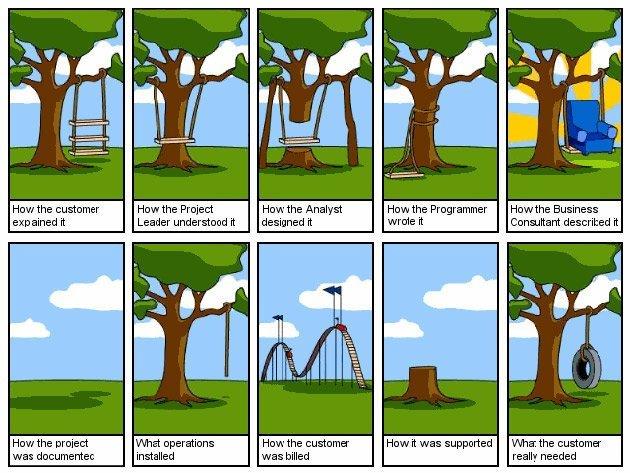
Seen this cartoon…it is very familiar to those in IT.

Given the huge divide between the onsite and offshore resources this inevitably happens on every other project if not every project. sometimes it applies on the whole, while at times it applies to portions of the project or work packets delivered. Keeping both sides- onsite and offshore, the vendor and the client on the same page takes a lot of skills, leadership, crisp reporting, keeping communication channels open, utilizing the available collaboration tools and fixing accountability and responsibility where it belongs.

Dont wait for things to cascade towards delivering a wrong product. it will be the case of Operation successful – Patient dead or Project complete and success but client tosses it out of the window since it didn’t meet his expectations he set before you began the project.