Impact of Globalization – Part 1

Globalization has brought in tremendous changes  world over some good and some not so good.  This has troubled planners world over to adapt in several ways while others struggle to grapple with the rapid changes it has brought upon almost every sphere of our lives.  In Addition to Globalization, demographic changes and adoption of Industry 4.0 and exponential technologies in the next five years will have the highest impact on jobs by 2022.

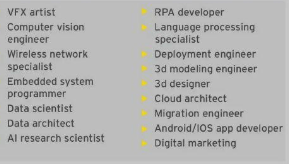
The outsourcing industry is not insulated by these impacts, they dont have the luxury of time to adapt to the fast changing landscape.  Looking at the sheer statistics it points to the huge change. 10% of this workforce will be thrust into new jobs that dont exist today, 40% into joins that require new skill sets and rest face an existential threat.   The picture below depicts the new roles that will need great deal of skills to  adapt and survive.

New job roles

Many traditional firms have done little than trying to play around the edges.  Selling digital technologies, cloud,  RPA and AI has been on the upswing without the underlying up gradation of current  resource pool via training or investing in the pipeline focused on the newer technologies and the emerging roles that has brought forth.

Almost all of the legacy firms continue to imagine that outsourcing will just move to these new roles for them to move into without understanding the skill set impact and the need to prepare from bottom up.  A good portion of these firms will lose their relevant, we are already seeing the impact of this slowly which will compound besides of course the Visa regime, rise of socialist parties championing against immigration from the under developed to developing countries. The success at the polls in some of the European countries that advocated open immigration is a wake up call.  These are certainly attributable to the impact of globalization.

Using process over Tech in outsourcing

In the age of RPA, AI we still have lot of lengthy documents of SOP (Standard Operating Procedures) in use today as part of outsourcing.  These are legacy ways of doing business that originated in the initial wave of outsourcing be it IT BPO or KPO.   Many of these didn’t take advantage of automation for various reasons, in same cases it was the reluctance of the business owners who feared for their jobs or wanted job security.  This is any leaders nightmare since these process often fail due to the human element involvement in executing looking at outdated documents.  Agreed, process need to be documented but not to a point they become useless to get work done efficiently.

The surprising element is proliferation of these and the belief of the business owners that hold on to these dear to their heart stating this works or this is the right way to do instead of looking at technology to reduce the sheer number of steps in each process. These are drag on business looking to be agile, innovate or reduce their time to market.  Some of these have become impediments to modernization or taking advantage of digital and emerging technologies.  With long term contracts some of these wait for its time to even get attention to modernize. The very existence of business is at stake with this legacy approach not to mention the hard and soft dollars spent on this besides lost opportunities.

Traditionally the operations team put out these lengthy SOPs to help enable outsourced providers run shops by the book.  Over a period of time these became a norm than looking to embrace technology and automate and thus reduce the process oriented work struck with human element getting it right all the time

These SOPs dont keep pace with technology changes happening in tandem  and remain outdated resulting in serious errors. These are high maintenance that leads to lot of wastage as well. Companies that have not embraced Agile, Scrum, Dev-ops suffer the worst fate of these lingering around slowing them down to make progress.  Bringing Operations and technology together will bring a more better outlook to retire these with the help of technology innovation.

The birth of RPA, AI, BOTS etc came out partly of this frustration.  The argument continues whether technology can solve all of these or let process written in SOPs drive operations.   Its high time both sides realized the importance of using technology and reduce the lengthy manual procedures written in old fashion SOPs and move towards a more competitive landscape.  Some  clients have problem moving these into RPA / AI and are paying lot more or taking extended time to ease into thEse newer ways of doing business effectively or completely bringing in new systems to take over with less cumbersome manual element.

In the era of self service the days of outsourcing to third party with a lengthy SOP for every process is almost near its end.  The earlier we adopt technology over writing business process the better we are serving our customers and adding to the bottomline.

Is in-sourcing booming…

For many  years, American companies have been saving money by “offshoring” jobs — hiring people in India, Philippines,  China and other distant low cost countries.  Slowly some of these jobs are making its way back into the  United States.

For some of the companies based in US, now the meaning of outsourcing is to keep it here in US than in distance locations and they are happy about it.   Some of the firms in US are  flourishing niche in the tech world as some American companies pull back from the idea of hiring programmers a world away.

Salaries have risen in places like South Asia, making outsourcing there less of a bargain. In addition, as brands pour energy and money into their websites and mobile apps, more of them are deciding that there is value in having developers in the same time zone, or at least on the same continent to enhance their go to market strategy, utilize their subject matter experts here, maximize their onshore investments,  poor performance of their offshore partners, frustration with the whole model  just to name a few.

Many of these domestic outsourcers are private, little-known companies  that are making waves while the behemoths like IBM lone of the country’s foremost champions of the offshore outsourcing model, has announced plans to hire 25,000 more workers in the United States over the next four years. As a result, the growth of offshore software work is slowing, to nearly half the pace of recent years.

The India based pure play firms are feeling the heat while the The nature of work is changing .   Vishal Sikka, chief executive of Infosys, an Indian outsourcing giant. “It is very local. And you often need whole teams locally,” a departure from the offshore formula of having a project manager on-site but the work done abroad.  “It’s not enough to have people offshore in India,” he added. Infosys announced in May that it planned to hire 10,000 workers in the United States over the next two years, starting with centers in Indiana and North Carolina. TCS, WipRo are not lagging behind as well, they have been beefing up local hiring in US.

Research firm IDC estimates yearly growth of 8 percent for offshore services industry. The rate in the previous five years was 15 percent.  Thus domestic sourcing is here to stay, and it’s going to grow rapidly.

The first wave of internet-era digital change in business, starting in the 1990s, focused mainly on automating back-office tasks like payrolls and financial reporting. The software involved was a collection of huge programs maintained by armies of engineers.  The internet allowed that work to be sent to low-wage nations, especially India. That brought the rise of the big outsourcing companies like Tata Consultancy Services, Wipro and Infosys.

Offshore services companies still excel at maintaining the software that runs the essential back-office systems of corporations. But today, companies in every industry need mobile apps and appealing websites, which can be made smarter with data and constantly updated. That software is best created by small, nimble teams, working closely with businesses and customers — not shipped to programmers half a world away.
The headaches of navigating time zones, cultures and language often outweighed the cost savings. Those problems go away with domestic outsourcer.  Hubs in non Technology cities are doing well to tap skilled people who want jobs in the technology economy without leaving the Midwest, where living costs are far less.Every business now realizes it’s a digital business and they need technical help, and that’s really driven the demand for our U.S.-based talent.Politics seem to be playing a role, too. The American onshore companies say they are seeing a post election spike in client inquiries, as President Trump lobbies businesses to create more jobs in the United States and seeks to curb immigrant work visas. The election has brought a lot of attention to these issues in additional to the visa curbs and tightening of the posture on H1Bs specifically.
Rising labor costs abroad also make domestic sourcing more attractive. A decade ago,  an American software developer cost five to seven times as much as an Indian developer. Now, the gap has shrunk to two times.
But the sales pitch made by onshore companies is not about raw labor costs. Instead, they claim the ability to deliver excellent work more efficiently than the offshore providers and less expensively than large technology services companies.  Many US based companies have cut its use of offshore by using providers locally and with some jobs being brought back. For long American industry has relied too much on overseas technology workers and neglected the potential talent here.  With wages stabilizing here and costs rising overseas by a faster clip and technology rapidly changing towards Cloud, AI, RPA etc the time is ripe for this trend to see an uptick.

IT Decisions that prove costly in an outsourced world…

Often senior IT Leaders  can make terrible judgement in the choice of projects or products or both. In the mix of the global footprint and the outsourced world, these decisions backfire not just implementing them but much after they go live.

Two examples to underscore how this plays out, these are real world examples without naming the client or the vendor for confidentiality reasons.

A large multinational company with global presence in 100 plus countries has a travel card program which is quite smooth and is delivering value and in steady state.  The competitor, beaten by market forces and looking for some quick wins, walks in and offers a signup bonus to switch,  The executive in charge of decision making doesn’t quite understand the complexity to switch worldwide and offers to take the bite.  Then begins the travails of handling the switch that spans IT, every employee that travels globally and uses the card and the administrators of the program not to mention the system switch.  What was thought to be an easy swap turned out to be a year-long disaster with negative ROI to boot.  Making a decision without all the inputs from key constituencies was the issue here.

Another example…The Same client had a need to handle automation of finance payables and was looking for a solution to reduce manual processing with outsourced labor.  Ignoring best of the breed products that could have delivered a quick win the decision maker proposed going in with the same outsourced vendor to buy their solution.  This solution was not production ready nor tested well and this decision cost the company literally thrice the amount that was intended to be saved.

These examples play out regularly at almost all companies that seek to outsource or reduce their IT costs. Adequate due diligence, testing the waters via pilot, having good exit clauses, limiting contractual damage are some things to consider to minimize the damage.

IT Leaders have a duty to let decisions makers know what their key decisions mean for implementation and beyond from ROI perspective. Honest truths are better than the irrational decision that hurts the company’s bottom line, spreads a sense of discontentment with users and becomes a Damocles sword for others.  

Larger IT product decision in outsourced environments are best taken with adequate due diligence rather than rushing in to capitalize on an immediate gain which is as good as buying snake oil. Some of the best decision makers are those that take feedback from every quarter and make an informed decision.  Bring IT to the table before key decisions are made is the key.   My way or highway approach here is a sure shot recipe for disaster.